a*(1−b)
products and scaling= a × (1 - b)a reduced as b rises: all of a at b = 0, none at b = 1.
SEE IT MOVE
Computed in your browser with KINSPIRATION's FUN engine. Drag on the map to try any a and b.
WHAT TO KNOW
INPUTS
a: the modulation; b: the amount that takes it away, usually unipolar.
OUTPUT RANGE
-1..+1 (up to twice a when b is -1, clamped)
USE IT FOR
A modulation that a controller takes away (a vibrato that aftertouch removes, a layer that velocity fades out); the falling side of a crossfade built from FUNs. LFO1 × (1 − LFO1), its only real use in the factory programs (14 layers), reshapes the wave into x − x².
WATCH OUT
The factory count looks big but is mostly empty: 1162 of its 1176 slots have both inputs OFF, unused FUN slots that keep this equation.
IN THE FACTORY PROGRAMS
In 1176 FUN slots of the factory programs: FUN3 556, FUN1 317, FUN4 112, FUN2 105, GFUN4 61, GFUN2 25. GFUN2 and GFUN4 are the program's global FUNs. 1162 of these slots have both inputs OFF, unused slots that keep this equation: its real uses are 14.
MOST USED INPUTS (a, b)
WHERE THE OUTPUT GOES
FIND THEM ON YOUR K2700
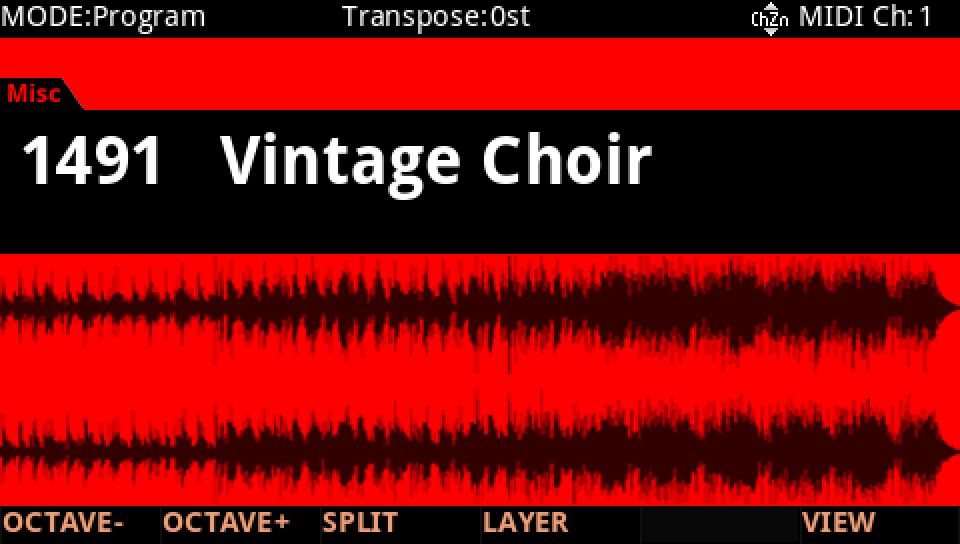
HOW TO ON YOUR K2700 · 1491 Vintage Choir
Vintage Choir uses a*(1-b) on its layer 1: see it, then where it goes.
In Program mode choose 1491 Vintage Choir (KEYPAD, 1491, ENTER).
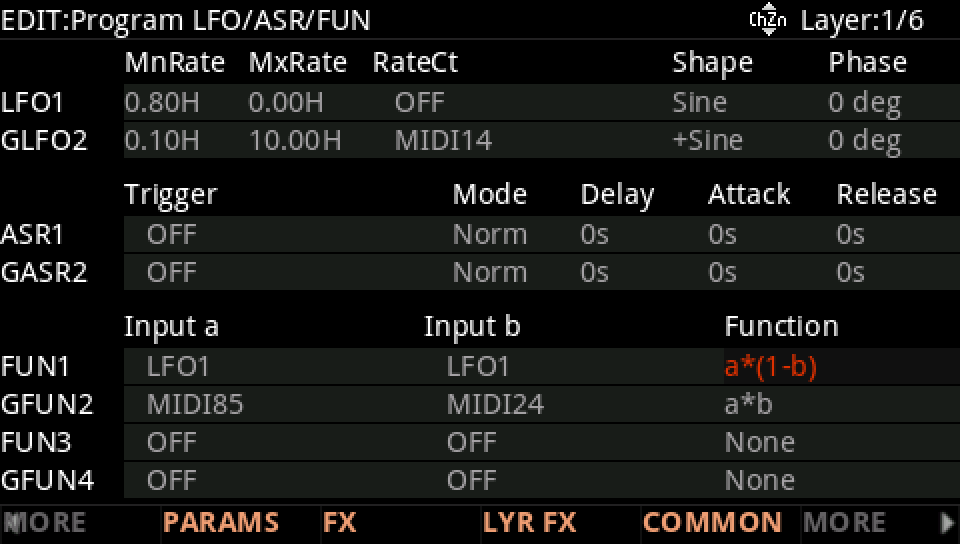
Press EDIT, then MORE and LFO+. The FUN1 row: Input a LFO1, Input b LFO1, Function a*(1-b).
Where it goes: MORE, DSP MOD. On the Pitch row Source 2 is FUN1, its depth from 0 ct to 50 ct as Press+MW rises.
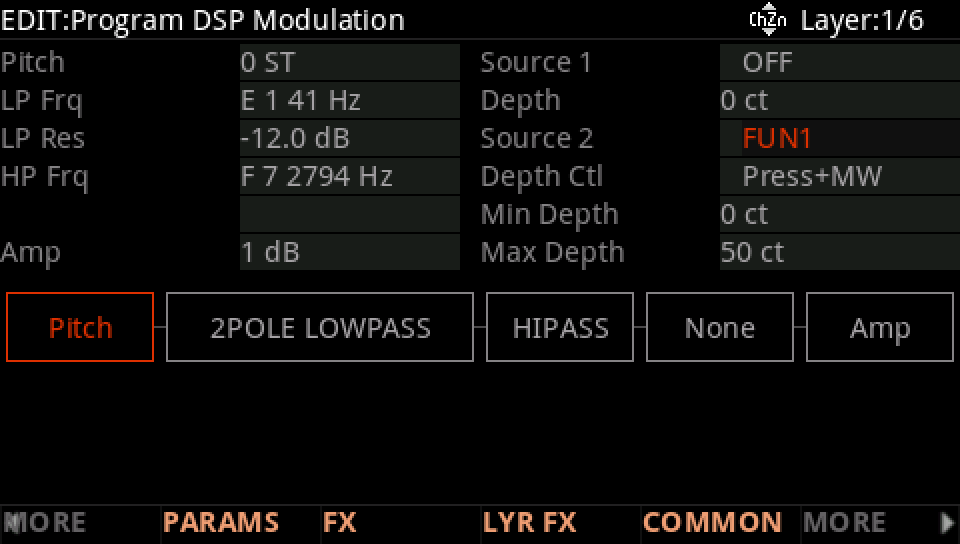
Hold a note: the Pitch row follows FUN1, LFO1 × (1 - LFO1).
Press EXIT and answer NO to leave the factory program as it was, or SAVE to keep your version on a USER ID.