a*b
products and scaling= a × bMultiplies the inputs, so one source scales the other. It does what a row's Src2 with a DptCtl and a MinDepth of 0 does, but its result can be read anywhere: by several rows or by another FUN.
SEE IT MOVE
Computed in your browser with KINSPIRATION's FUN engine. Drag on the map to try any a and b.
WHAT TO KNOW
INPUTS
Symmetric: usually a modulation and the amount that scales it.
OUTPUT RANGE
-1..+1 (0..1 when both inputs are unipolar)
USE IT FOR
A controller scaling an LFO (a vibrato or tremolo depth); ASR × LFO for a delayed vibrato; an envelope scaled by velocity; a switch gating a controller. The factory's MIDI85 × MIDI24 (424 global FUN2s) lets Button 5 enable Slider 5's 'Motion' amount; MIDI28 × MIDI90 (165) is the reverb amount times the reverb on-switch.
WATCH OUT
Two bipolar inputs give a positive result when both are negative.
IN THE FACTORY PROGRAMS
In 3110 FUN slots of the factory programs: FUN3 970, FUN1 805, GFUN2 514, FUN4 344, GFUN4 240, FUN2 237. GFUN2 and GFUN4 are the program's global FUNs.
MOST USED INPUTS (a, b)
WHERE THE OUTPUT GOES
FIND THEM ON YOUR K2700
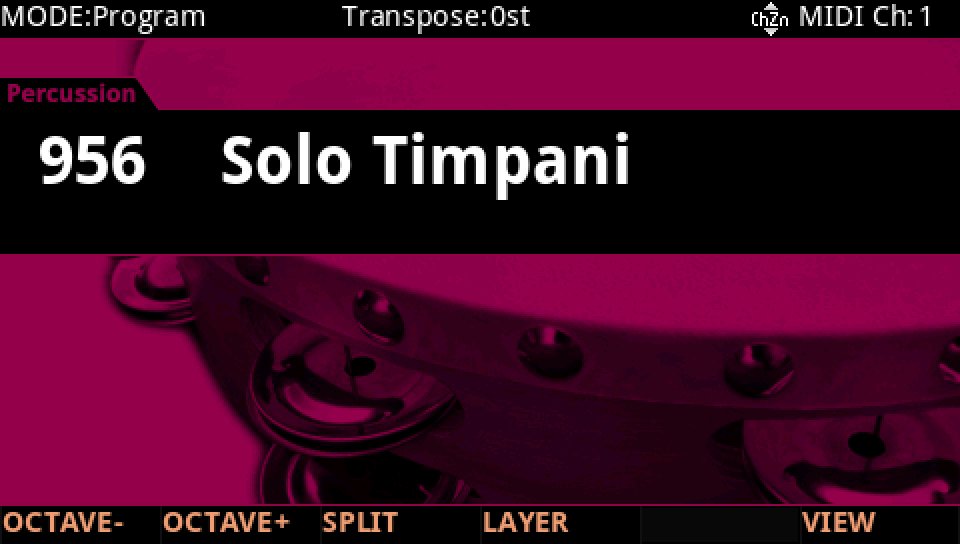
HOW TO ON YOUR K2700 · 956 Solo Timpani
Solo Timpani uses a*b on its layer 1: see it, then where it goes.
In Program mode choose 956 Solo Timpani (KEYPAD, 956, ENTER).
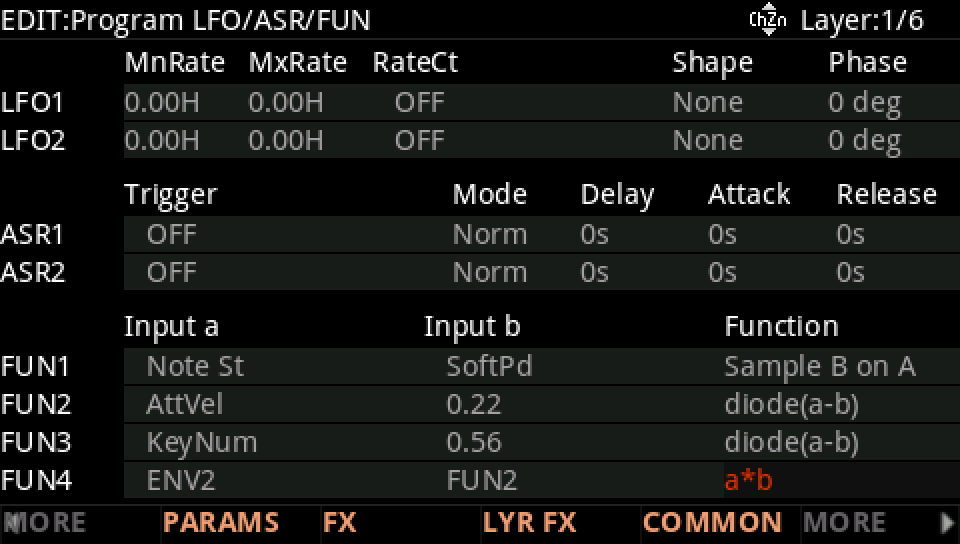
Press EDIT, then MORE and LFO+. The FUN4 row: Input a ENV2, Input b FUN2, Function a*b.
Where it goes: MORE, DSP MOD. On the LP Frq row Source 1 is FUN4, with a Depth of 3800 ct.
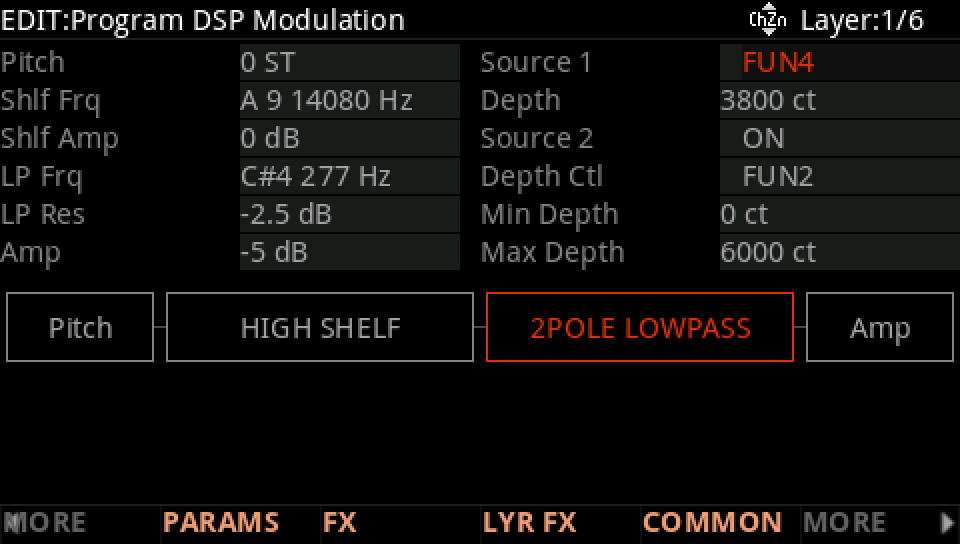
Hold a note: the LP Frq row follows FUN4, ENV2 × FUN2.
Press EXIT and answer NO to leave the factory program as it was, or SAVE to keep your version on a USER ID.