diode(a−b)
diodes= a - b, or 0 where that is negativePasses how far a is above b and nothing below: a one-sided window. Only positive results matter: a negative result becomes 0, which limits a bipolar signal to unipolar values.
SEE IT MOVE
Computed in your browser with KINSPIRATION's FUN engine. Drag on the map to try any a and b.
WHAT TO KNOW
INPUTS
a: the signal (AttVel, KeyNum, an LFO, a controller); b: the threshold, usually a constant (OFF passes a's positive half).
OUTPUT RANGE
0..+1 (never negative; at most 1 - b for a unipolar a)
USE IT FOR
Velocity layers that grow only above a velocity, as a depth control: AttVel - 0.44 opens from velocity 57 (418 factory slots), 0.84 from 108, 0.50 from 65, 0.26 from 34; key-range modulation above a split: KeyNum - 0.56 from C5, 0.58 from D#5, 0.64 from A#5; only the upper half of an LFO (b OFF).
WATCH OUT
The output is not rescaled: AttVel - 0.84 reaches only 0.16 at velocity 127, so the destination needs a large depth. A velocity v passes a constant c when v > 128 × c, a key k when k > 128 × c (C4 = 0.47, C5 = 0.5625).
IN THE FACTORY PROGRAMS
In 1894 FUN slots of the factory programs: FUN2 814, FUN3 612, FUN1 415, FUN4 49, GFUN2 3, GFUN4 1. GFUN2 and GFUN4 are the program's global FUNs.
MOST USED INPUTS (a, b)
WHERE THE OUTPUT GOES
FIND THEM ON YOUR K2700
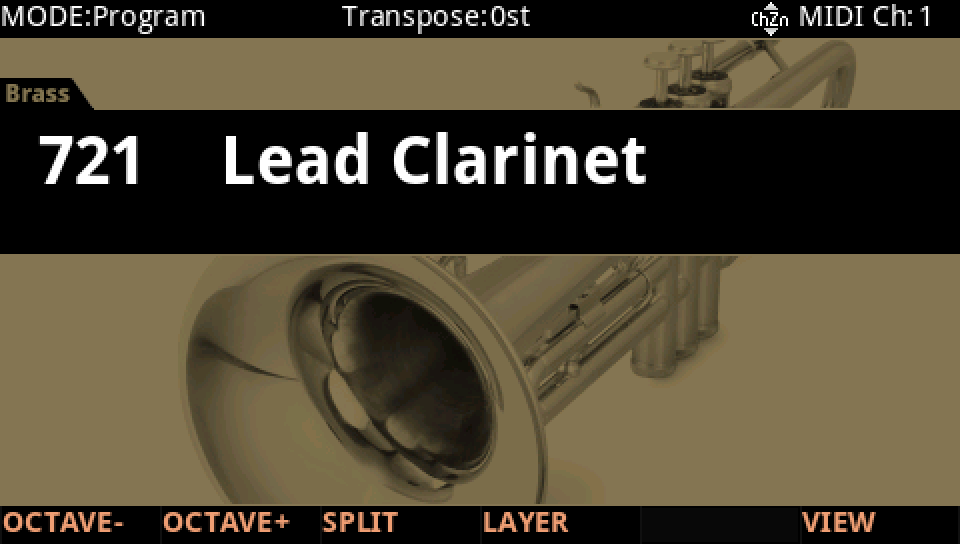
HOW TO ON YOUR K2700 · 721 Lead Clarinet
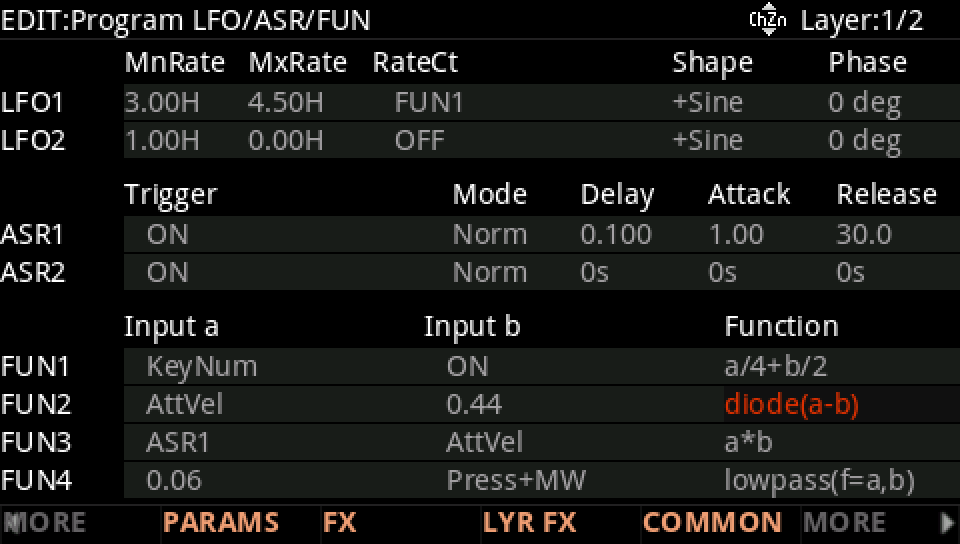
Lead Clarinet uses diode(a-b) on its layer 1: see it, then where it goes.
In Program mode choose 721 Lead Clarinet (KEYPAD, 721, ENTER).
Press EDIT, then MORE and LFO+. The FUN2 row: Input a AttVel, Input b 0.44, Function diode(a-b).
Where it goes: MORE, DSP MOD. On the LP Frq row FUN2 is the Depth Ctl: it sets Source 2's (ENV2) depth from -1100 ct to 4000 ct.
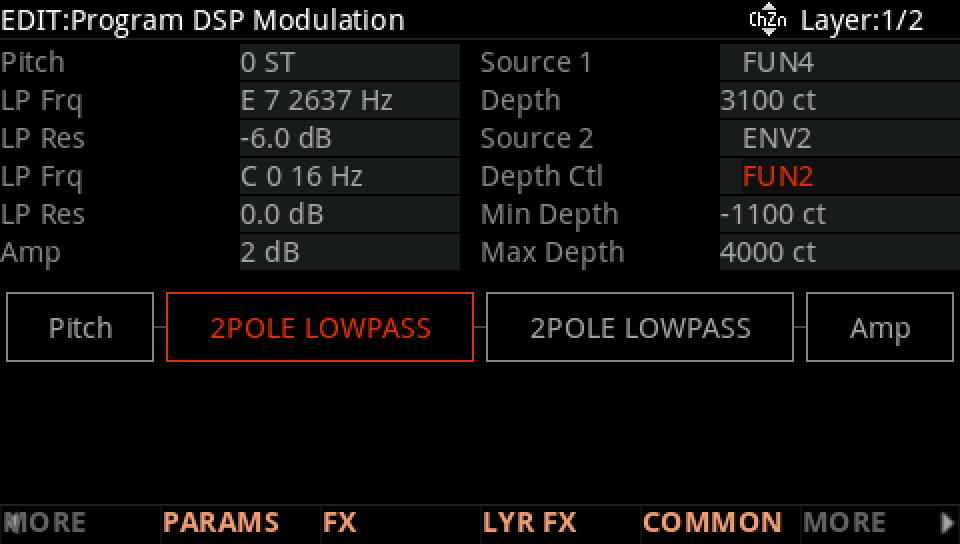
Play softly, then hard: the LP Frq row follows FUN2.
Press EXIT and answer NO to leave the factory program as it was, or SAVE to keep your version on a USER ID.