Where it goes
DestinationPITCH · AMP · a filter · an LFOAn ASR does nothing until a field reads it. On AMP it fades the level, on a filter's frequency it opens or closes it, on the pitch it bends the note, as an LFO's rate control it speeds the LFO up, and as a depth control it brings a modulation in.
SEE IT MOVE
Computed in your browser with KINSPIRATION's ASR engine, frame by frame.
WHAT TO KNOW
WHERE
A field's Src1 or Src2 with a depth in its own units (dB, cents), a depth control (DptCtl) that scales another source, an LFO's RateCt, or a FUN's input.
DEPTHS
Negative depths make the destination fall as the ASR rises: a level that sinks, a filter that closes, a pitch that dives.
USE IT FOR
A delayed vibrato (the ASR as the vibrato's depth control), a fade-in or a fade-down, a filter that opens late, a fall-off at the end of a note.
WATCH OUT
The ASR adds its depth on top of the field's own value: a filter set wide open cannot open further. Pitch depths in the thousands of cents are dives and blips, not bends.
IN THE FACTORY PROGRAMS
The factory's ASRs go to 903 FUN inputs, 100 pitch rows, 178 AMP rows, 166 LFO rate controls and 234 depth controls; on AMP their median depth is -6 dB.
WHERE THEY GO
THE AMP DEPTH
FIND THEM ON YOUR K2700
HOW TO ON YOUR K2700 · 698 Triumphant Horns
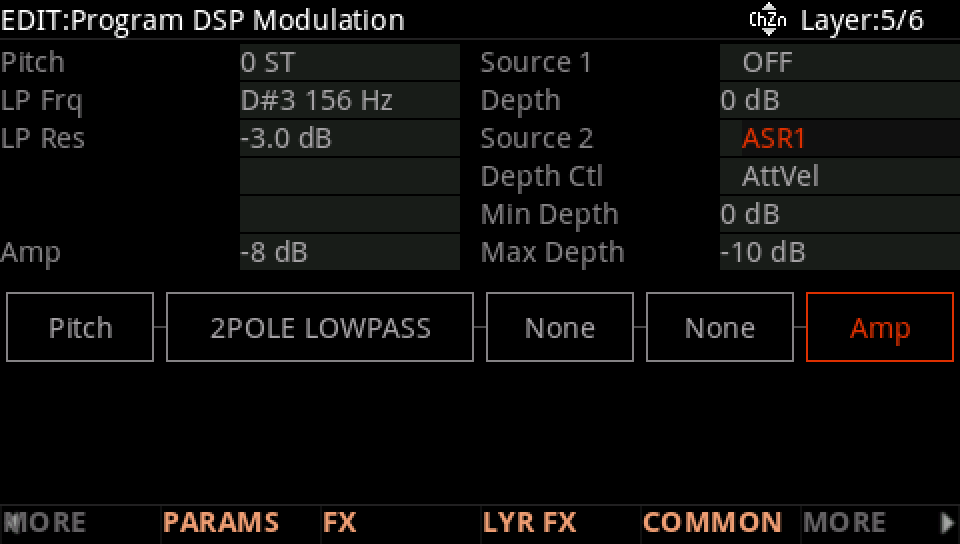
Triumphant Horns's fifth layer sinks 10 dB after its attack: ASR1 on the AMP.
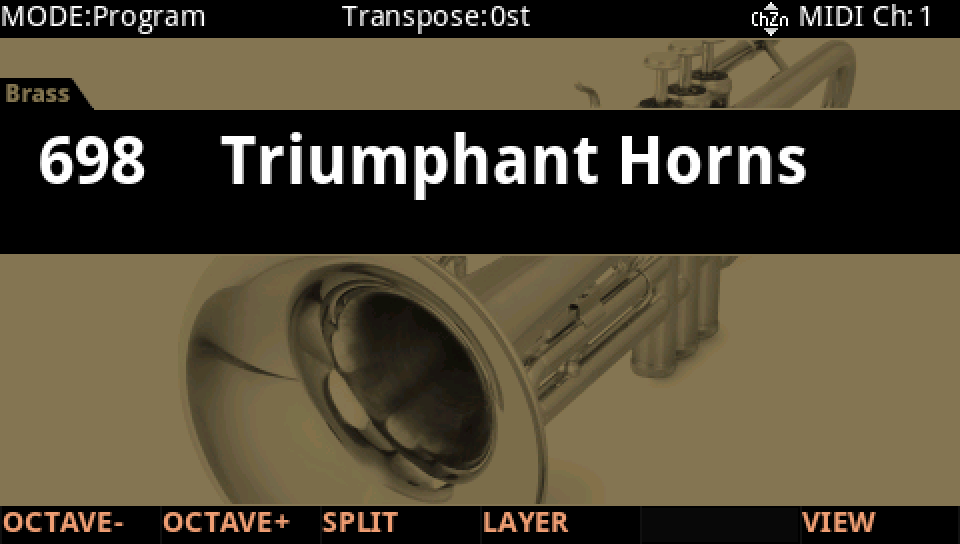
In Program mode choose 698 Triumphant Horns (KEYPAD, 698, ENTER).
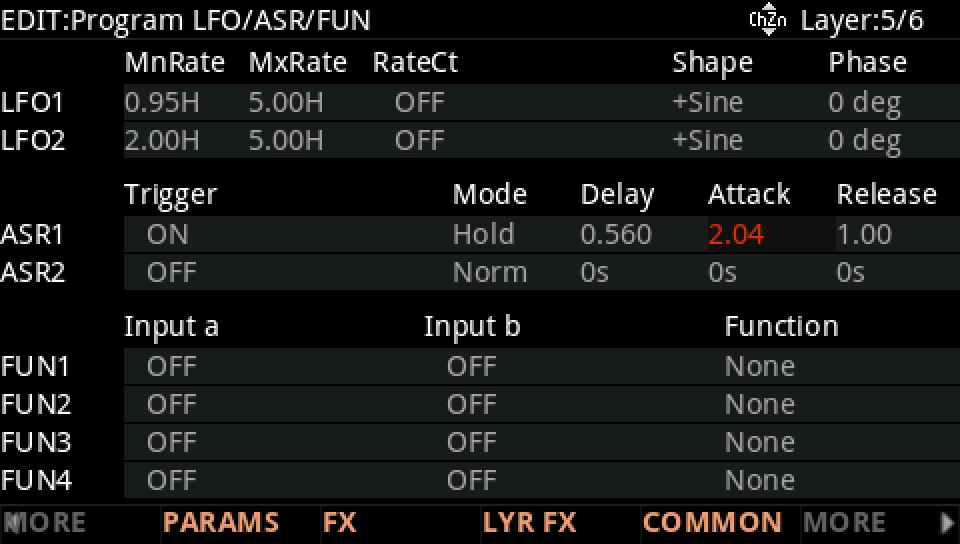
Press EDIT, go to layer 5 (CHANNEL/LAYER ▲), then MORE and LFO+. ASR1: Delay 0.56 s, Attack 2.04 s, in Hold.
MORE, DSP MOD. On the Amp row Source 2 is ASR1, its depth from 0 dB to -10 dB by AttVel: as the ASR rises the level falls, more for a harder note.
Press EXIT and answer NO to leave the factory program as it was, or SAVE to keep your version on a USER ID.