In series, and alongside
Wiringin series · a second wireIn most ALGs the places follow each other: each one takes the place before it. Others run a second wire, the B input, from further back (the KEY, or an earlier place) into a place that takes two inputs: the sound processed and the sound as it was, side by side, joined there.
SEE IT MOVE
Computed in your browser with KINSPIRATION's DSP functions, sample by sample; the KEY is the Sawtooth Wave keymap.
WHAT TO KNOW
IN SERIES
ALG 1, 2, 5, 6, 7, 8, 9 and 28: each place feeds the next. 13 ALGs are only that, and the factory uses them most.
A SECOND WIRE
Below the diagram a line runs from the KEY or a place to a B: that place adds, mixes, crossfades or multiplies its two inputs.
USE IT FOR
A dry signal mixed with a filtered one, a filtered sample under an oscillator, two filters side by side.
WATCH OUT
The B input of a mixer is 18 dB down at the default Pad: raise its level, or take the Pad down, before deciding the second wire does nothing.
IN THE FACTORY PROGRAMS
13 ALGs are in series only, 7,492 factory layers; 75 run a second wire, 616 layers.
IN SERIES
WITH A SECOND WIRE
FIND THEM ON YOUR K2700
HOW TO ON YOUR K2700 · 129 StBaroque Harpsi
StBaroque Harpsi's second layer runs the KEY on two wires: through a filter, and around it.
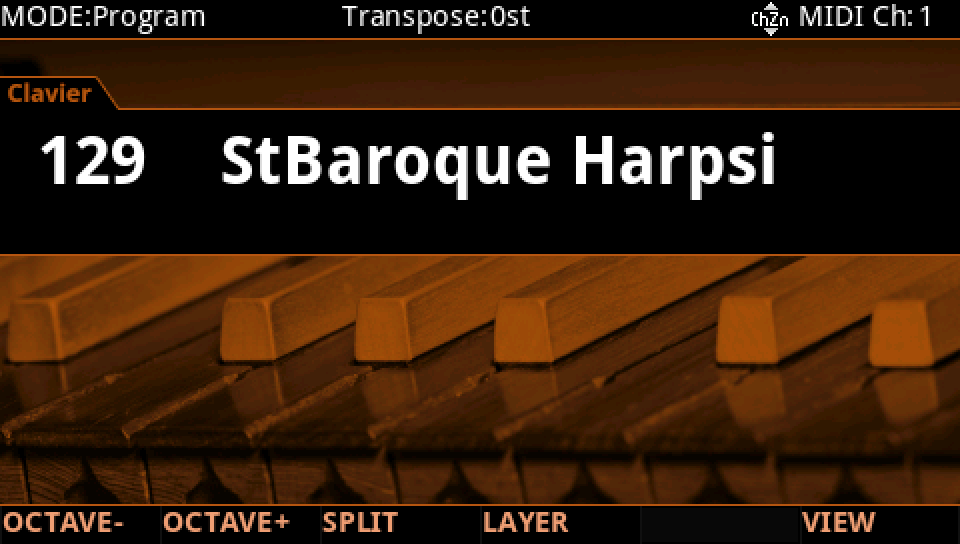
In Program mode choose 129 StBaroque Harpsi (KEYPAD, 129, ENTER).
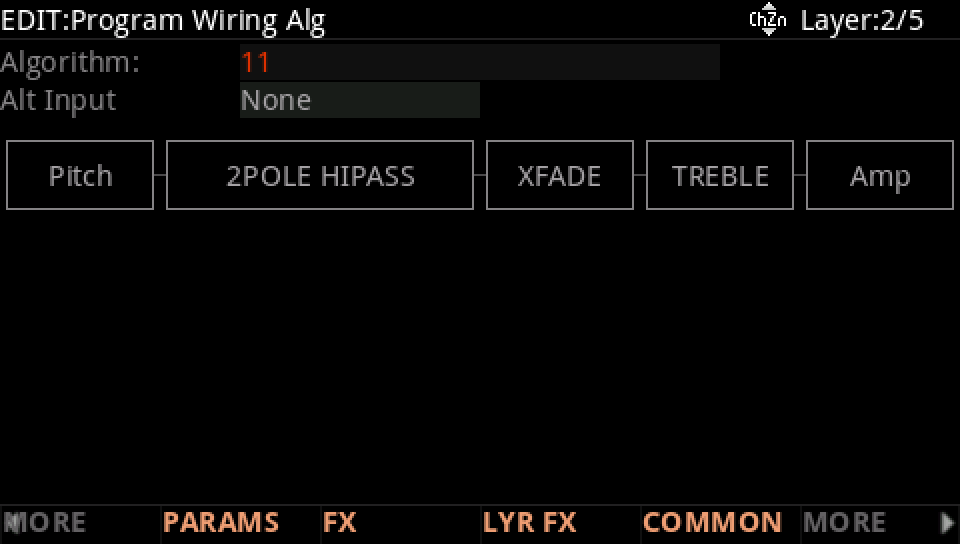
Press EDIT, go to layer 2 with CHANNEL/LAYER ▲, then MORE and ALG: Algorithm 11, a 2POLE HIPASS in F1-F2, an XFADE in F3, TREBLE in F4. ALG 11 also takes the KEY straight to F3, beside the filter.
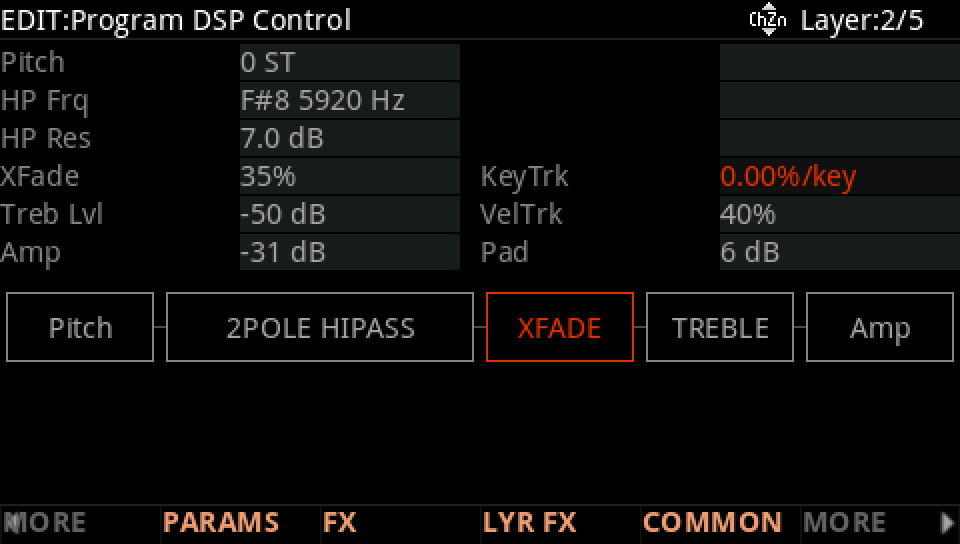
MORE, then DSP CTL, the XFade row: 35%, the share of the KEY as it was; the rest is the high-passed sound.
Press EXIT and answer NO to leave the factory program as it was, or SAVE to keep your version on a USER ID.