hipass(f=a,b)
lag filters= b - lowpass(f=a, b): b minus its own lagged copyPasses changes and forgets steady values: a jump in b goes straight through, then the output sinks back to 0 at a speed set by a.
SEE IT MOVE
Computed in your browser with KINSPIRATION's FUN engine, step by step: this FUN keeps a state, so its output depends on what came before.
WHAT TO KNOW
INPUTS
a: the speed of the return to 0, a constant as for lowpass (or a controller); b: the source.
OUTPUT RANGE
-1..+1 (a rising b gives a positive pulse, a falling one a negative)
USE IT FOR
A blip at each change: hipass(0.26, Note St) is a spike at note-on that fades over about 0.1 s, and a dip at note-off (19 factory slots); a pulse at note start with its decay on a slider (Ctl D and 0.99, Ctl D and ON: 21 slots); accents on controller movement, a filter that opens while a slider moves and settles when it stops.
WATCH OUT
The time for the output to fall 63 % of the way back to 0: a 0.02: 0.99 s, 0.05: 0.39 s, 0.1: 0.19 s, 0.25: 0.07 s, 0.5: 0.03 s, 0.9: 0.008 s; at a = 1 nothing gets through. A falling b gives a negative pulse.
IN THE FACTORY PROGRAMS
In 281 FUN slots of the factory programs: FUN1 102, FUN4 96, FUN3 79, GFUN4 2, FUN2 2. GFUN2 and GFUN4 are the program's global FUNs.
MOST USED INPUTS (a, b)
WHERE THE OUTPUT GOES
FIND THEM ON YOUR K2700
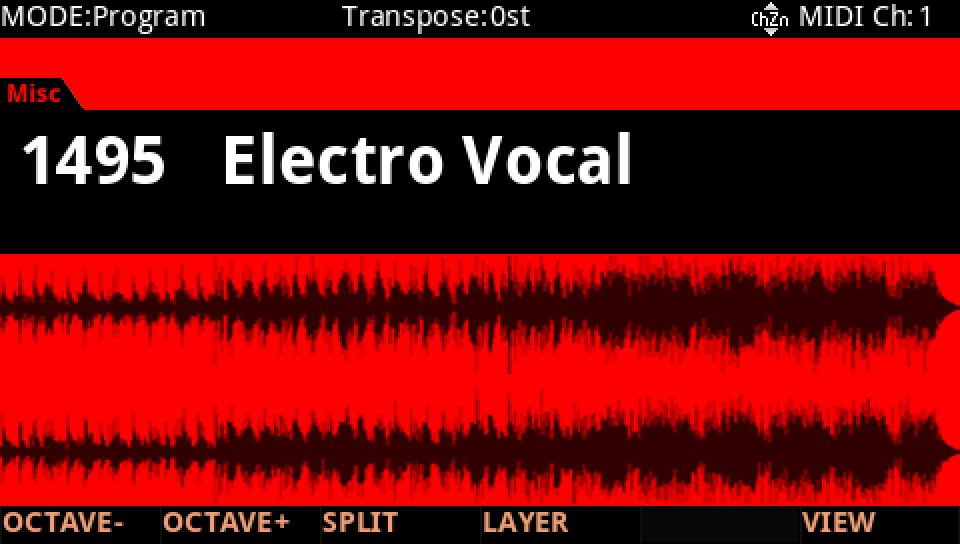
HOW TO ON YOUR K2700 · 1495 Electro Vocal
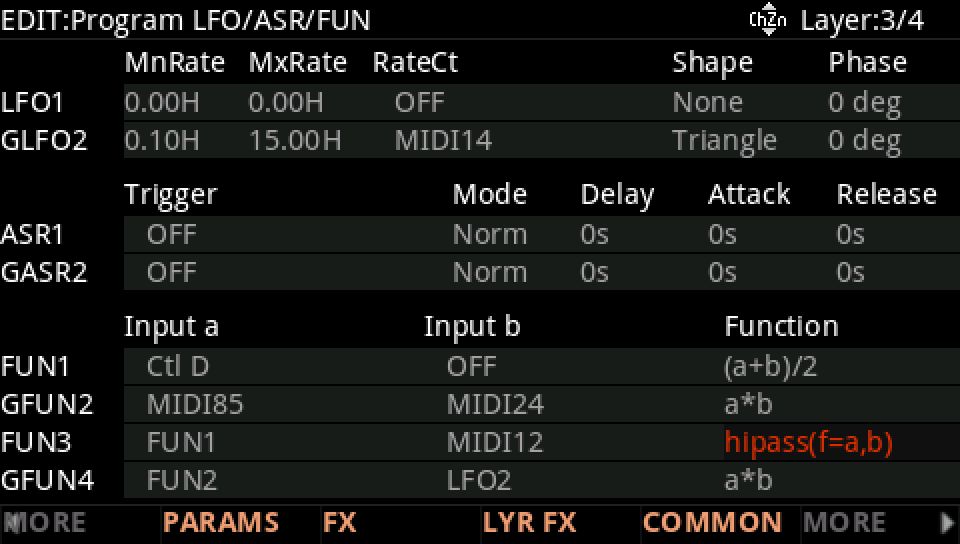
Electro Vocal uses hipass(f=a,b) on its layer 3: see it, then where it goes.
In Program mode choose 1495 Electro Vocal (KEYPAD, 1495, ENTER).
Press EDIT, go to layer 3 with CHANNEL/LAYER ▲, then MORE and LFO+. The FUN3 row: Input a FUN1, Input b MIDI12 (Slider 1), Function hipass(f=a,b).
Where it goes: MORE, DSP MOD. On the TP Frq row Source 2 is FUN3, its depth from 0 ct to -8000 ct as AttVel rises.
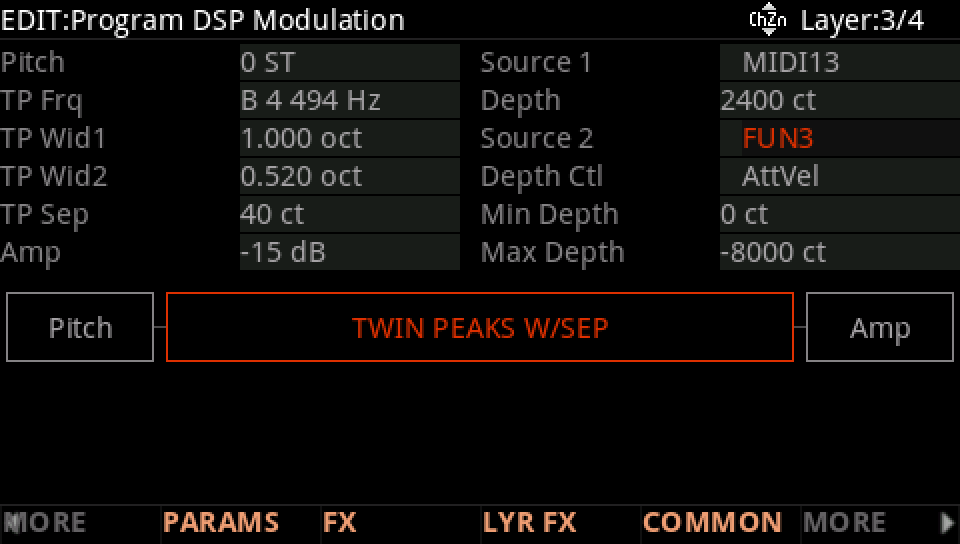
Hold a note. Move Slider 1 (MIDI12): the TP Frq row follows FUN3.
Press EXIT and answer NO to leave the factory program as it was, or SAVE to keep your version on a USER ID.